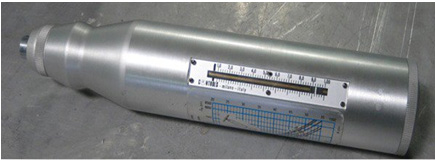
Rebound hammer test is one of the non-destructive concrete tests for the evaluation of the structure strength. Rebound hammer is known as Schmidt's Hammer. It is also known as Swiss Hammer because it is invented by Ernst Schmidt, a Swiss Engineer.
Rebound hammer test is conducted to assess the relative compressive strength of concrete. It is based on the hardness at or near its exposed surface.
In rebound hammer test, the spring controlled plunger of rebound hammer is pressed on the surface of concrete and the surface hardness is measured on graduated scale. This measured value is designated as Rebound Number. It is also known as Rebound Index. Concrete with low compressive strength and low stiffness has a lower rebound Number or Rebound Index.
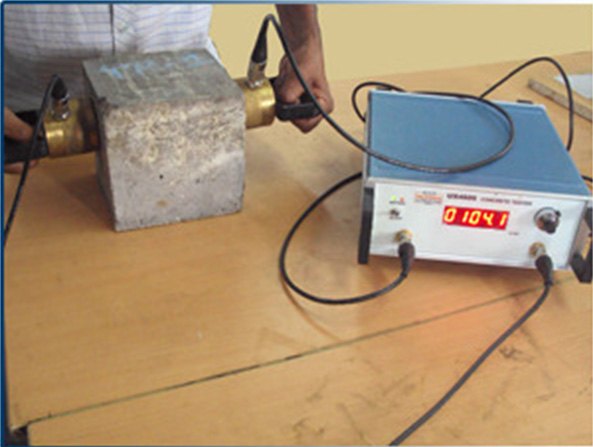
Ultrasonic pulse velocity test is also known as UPV test. Ultrasonic pulse velocity tests are recognised methods of non-destructive concrete tests. It is used to determine the strength by evaluating the homogeneity and integrity of the concrete. it is performed with the help of
This test consists of measuring the travel time of an ultrasonic pulse of 50-54 kHz. The pulse is produced by an electro-acoustical transducer system. The higher pulse velocity indicates higher elastic modulus, density and integrity of the concrete.
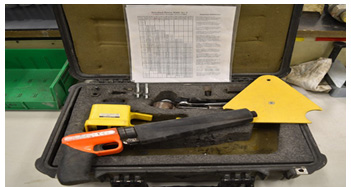
Penetration resistance test is one of the non-destructive concrete tests. It is used for determining the relative strength of concrete in the same or the different structure. Because of the nature of the equipment, it should not be expected to yield absolute values of strength.
The penetration resistance test for compressive strength depends on the type of aggregates (soft or hard). It is also depends on the size of aggregates and nature of equipment.
It is observed that approximately 20% accuracy may be possible in strength determination of concrete.
The pull out testing is one of the non-destructive concrete tests and it can be done with the LOK test and CAPO test. The test equipment designed to a specific geometry will produce pull out forces. The pull out forces are correlated to the compressive strength of concrete. This Correlation is achieved by measuring the force required to pull a steel probe of the Disc.
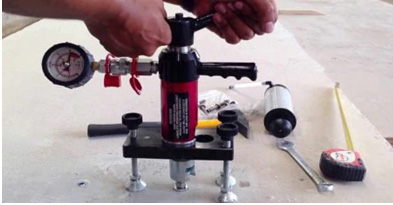
The Pull-off test is one of the non-destructive concrete tests to evaluate the existing structure strength. In Pull-off Test, the traction force (pull-off force) required to pull off a metallic disc bonded to a surface of the concrete is related to the compressive strength of the material.
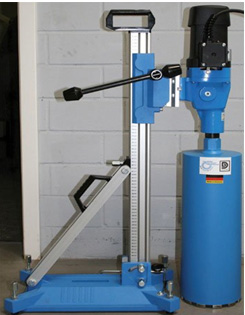
Cores are usually cut by means of the rotary cutting tool with diamond bits. A cylindrical core specimen is obtained with its ends being uneven, parallel, and square and embedded pieces of reinforcement with concrete core cutting machine.
It is then tested in compression testing machine in a moist condition as per BS 1881: Part 4: 1970 or ASTM 42-77.
The rational use of the various available Non-destructive Concrete Tests, as well as a possible combination of more than one test, can be particularly interesting from the viewpoint of the validity of results. The core test is more reliable, but during repairs or rehabilitation of existing structures, it is not always possible to do numbers of core tests. Again, it is costly also.
Hence We first carry out Rebound hammer test, which is suggestive of comparatively stronger and weaker areas. The doubtful areas than can be tested with Ultrasonic test. The core test would become a must where even the Ultrasonic tests suggest poor concrete. Therefor we have to use his experinece and judgment for carrying various tests in combination and make the judgement before determining any strengthening proposals.
We are certified professional NDT Level-II (ASNT)